Business Administration (BS) class guide
A current, source-bounded map for Business Administration (BS): open the program, choose the exact SNHU course code, then move into a verified module manual only when the real Brightspace deliverable is known.
This map links every Course ID publicly printed on the official program page plus unambiguous concentration examples. General education, transfer, elective and choice placeholders remain described rather than invented as a fixed personal schedule. The official directory identity, program link, native term structure, class destinations and right-side navigation are complete here.
Read the public program shape correctly
SNHU lists this as a current online bachelor program under Business, Healthcare. Its public page currently gives 40 total courses advertised on the official page. The table below links 18 course identities that the page names directly by Course ID or presents as an unambiguous concentration example.
That distinction matters. A 40-course bachelor's degree includes general education, major, transfer, elective and free-choice space; a master's track can share a common core while adding specialized work. A public marketing page does not freeze every student's plan, so this map never fills an unnamed choice with a plausible class. The current academic evaluation and advisor-approved plan remain authoritative.
The source was verified on July 30, 2026. Use the official page linked below to check later changes in availability, total credits, admissions rules and concentration naming before registering. The course links here are tutoring routes, not an enrollment promise.
The classes, one by one
| Course code | Published class title | Credits | Public basis |
|---|---|---|---|
| ACC 201 | Financial Accounting | 3 | official program-page Course ID |
| ACC 202 | Managerial Accounting | 3 | official program-page Course ID |
| BUS 206 | Business Law I | 3 | official program-page Course ID |
| BUS 210 | Managing and Leading in Business | 3 | official program-page Course ID |
| BUS 225 | Critical Business Skills for Success | 3 | official program-page Course ID |
| BUS 400 | Driving Business Opportunities | 3 | official program-page Course ID |
| INT 220 | Global Dimensions in Business | 3 | official program-page Course ID |
| FIN 320 | Principles of Finance | 3 | official program-page Course ID |
| OL 215 | Principles of Management | 3 | official program-page Course ID |
| MKT 205 | Applied Marketing Strategies | 3 | official program-page Course ID |
| IDS 105 | Cultural Awareness and Online Learning | 3 | official program-page Course ID |
| HUM 102 | Self, Society, and the Humanities | 3 | official program-page Course ID |
| ENG 130 | Foundations of Written Communication | 3 | official program-page Course ID |
| MAT 126 | Mathematical Reasoning for Modern Problem-Solving | 3 | official program-page Course ID |
| PHL 218 | Ethics in Global Society | 3 | official program-page Course ID |
| SCI 260 | STEM Principles and Problem-Solving | 3 | official program-page Course ID |
| SCS 260 | Social Issues and Decision-Making | 3 | official program-page Course ID |
| ACC 345 | Financial Statement Analysis/Business Valuation | 3 | concentration example |
Turn the program map into a term board
Start with the active registration record. For each course, record its term dates, module count, syllabus version, current grade weights, discussion requirements, Guidelines and Rubric documents, milestones, final project, examination rules and any experiential dependency. A directory tells you which program exists; only the live course tells you what is due.
SNHU's undergraduate rhythm normally spans eight modules, while graduate terms normally span ten. Build one board row per real deliverable rather than one guessed task per module. Some modules may carry a discussion and an assignment, some may stage a milestone, and others may focus on readings, quizzes, practice or a different instrument.
Use Eastern Time only when the current syllabus and course shell specify it, and record the time zone beside every converted deadline. Keep the initial discussion post, required replies and the main assignment as separate obligations. A finished paper does not repair a missed response requirement.
Make the Guidelines and Rubric document the work plan
Copy every scored criterion into a requirement ledger before researching. Each row needs an action verb, evidence source, destination in the draft, completion test and final status. When the document separates Proficient from Exemplary, translate that difference into something visible—stronger synthesis, a more specific application, clearer evidence, or a more complete explanation—rather than merely writing more words.
Keep assignment directions and rubric criteria side by side. Directions establish the situation, audience, file type and constraints; the rubric establishes what earns points. If the two use different order, organize the deliverable for the reader while preserving a visible destination for every scored row.
For a milestone sequence, maintain one decision ledger across the term: scenario facts, assumptions, data definitions, sources, stakeholder names, recommended choices and instructor feedback. The final project should integrate corrected milestone thinking, not paste earlier submissions together with contradictions intact.
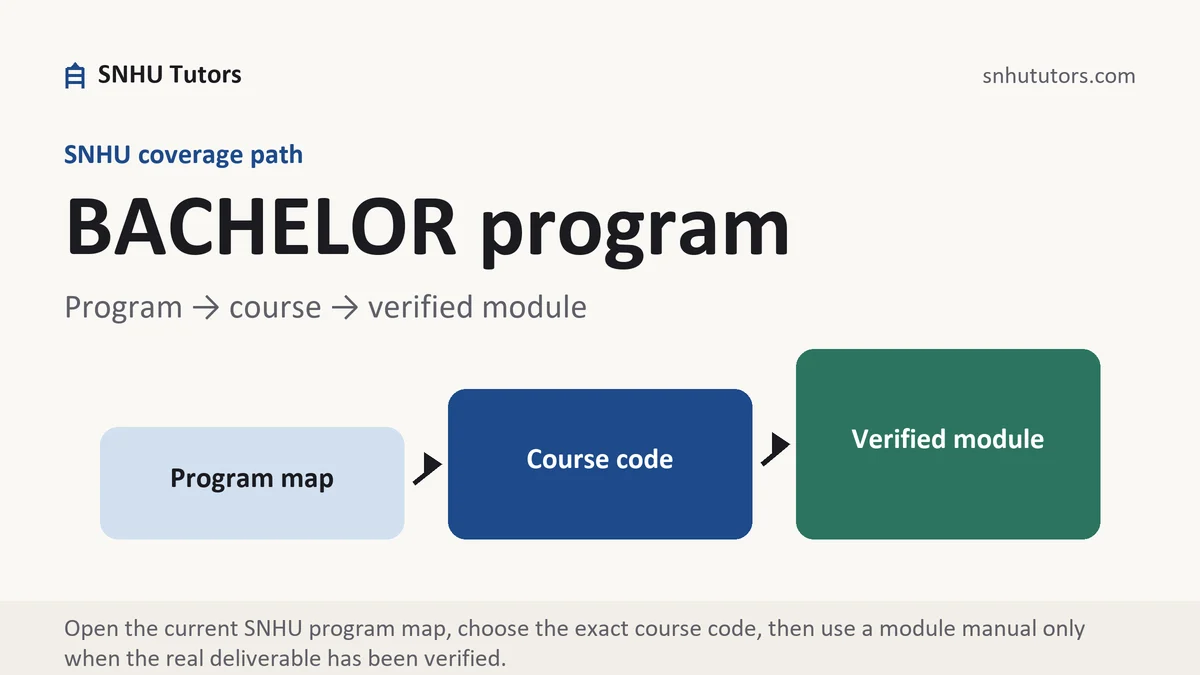
Program → course → module
This page owns the program layer. Each linked Course ID opens a full class guide with a module operating method, writing and evidence workflow, feedback loop and program backlinks. A real module manual is the next layer only when its actual deliverable identity is publicly verifiable.
Term length is never used to invent assessment titles. “Module 4” can contain different work after a course revision or section change, and a Milestone Two in one class says nothing about another. Where verification stops, the class page says so and asks for the current Brightspace directions and rubric.
Read the three layers for different questions. The program map answers which public degree or concentration names a class. The class guide answers how to control the work across the term. The module manual, when one can be verified, answers how one real deliverable is structured. Keeping those jobs separate prevents a broad degree description from being mistaken for a current assignment prompt.
When a student shares a live course artifact, verify the header, course code, module, version date, scenario, submission format and rubric before using it. Then place the artifact beneath the correct class without changing the program map. If a later term replaces the deliverable, preserve the historical distinction rather than silently treating both versions as one task.
This hierarchy also keeps navigation useful when a course belongs to several programs. The same class guide can link back to every current public program that names it, while the student still follows the single academic evaluation and live section that apply to the registered plan. Shared code does not mean shared concentration requirements, sequence or personal transfer outcome.
Quality controls across the whole path
Use a content pass before a formatting pass. Confirm that each rubric row has a visible answer, each recommendation follows from the analysis, every data claim has a source and period, every calculation exposes inputs and units, and each conclusion stays within the evidence. Then reconcile citations, references, headings, tables, slides, speaker notes, file type and filename.
After grading, classify feedback as coverage, reasoning, evidence, calculation, format or professional-boundary work. Correct the smallest complete unit, trace every dependent paragraph or exhibit, and add one prevention rule to the course ledger. Carry the method into the next module without recycling prose that belongs to a different task.
The student remains responsible for the real research choices, analysis, calculations, discussions, project decisions, authenticated work and final submission. Tutoring can explain, plan, review and rehearse; it cannot impersonate the student or manufacture experience.