Every written deliverable across the five MSN tracks, Family Nurse Practitioner didactics, Healthcare Quality and Safety, Nurse Executive Leadership, Nursing Education, and Population Health, drafted by MSN-prepared nurse writers in 24 to 48 hours: evidence-based practice papers, quality improvement proposals, leadership analyses, curriculum designs, population health assessments, plus the weekly discussion clock and the statistics spine in IHP 340. Criterion-mapped against each Guidelines and Rubric document, APA immaculate, revised free until the A-range grade posts. Clinical placement, practicum hours, and the FNP's immersion logistics sit outside this site's scope, your program office owns those, and our support keeps the writing from competing with them.
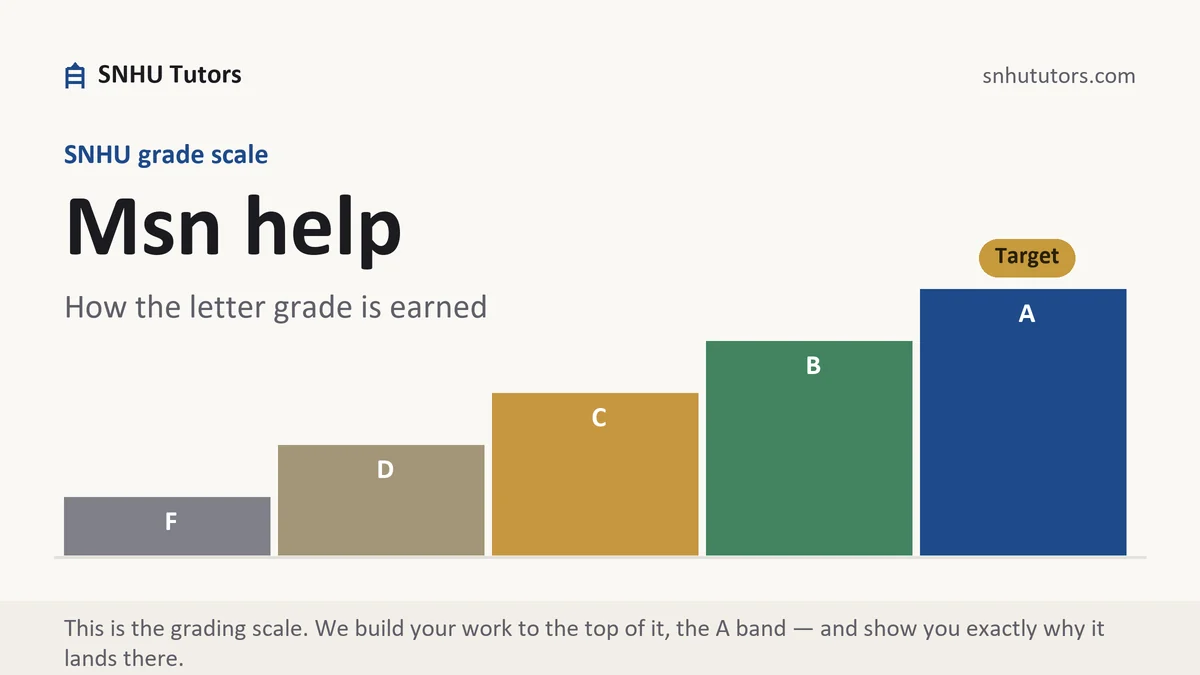
What graduate nursing rubrics grade
Three demands repeat across every track. Evidence discipline: claims sourced to current literature, appraised rather than name-dropped, in flawless APA, the single most common point leak for working nurses returning to academic writing. Practice specificity: quality proposals and leadership analyses grounded in a named unit's named problems, not healthcare-in-general. And graduate register: measured, precise, hedged where evidence is thin, the voice of a clinician writing for peers. Our nurse writers live in that register, and one sample paragraph of your context is enough to ground a whole paper in your actual practice environment.
Track-by-track service notes
- FNP didactics: the written courses drafted around your clinical calendar, heavy weeks absorbed so patient days stay protected
- Quality and Safety: QI proposals with real measurement logic, baselines, targets, and methods that would survive an actual committee
- Executive Leadership: strategy and finance-adjacent analyses in administrator register, numbers committed
- Nursing Education: curriculum and assessment designs aligned objective-to-evaluation, the education rubric's favorite thread to pull
- Population Health: community assessments with the epidemiology handled correctly and the interventions costed like they might run
The milestone arcs and the capstone-facing finish
MSN courses scaffold like the rest of SNHU, milestones feeding substantial final papers and projects, and the compounding logic hits harder at graduate stakes: $1,977 per course makes a retake the most expensive bad week available. The milestone desk holds each arc with one nurse-writer team; the final project desk assembles the finishes; and the term-level plan, two courses or one, sequenced around your unit's realities, comes free from the main desk. Nurses finish this degree tired everywhere; supported clients finish it tired only from the job.
What the five tracks grade, in writing terms
The five specializations share one writing engine, evidence appraised in current APA and claims grounded in a real practice setting, but each track grades a different move, and knowing which move your rubric documents reward is worth more than any general essay advice. Wherever your track begins, the catalog's evidence spine sets the register early: NUR 506 Evidence-Based Practice grades critiquing, generating, and translating research evidence into practice, NUR 550 Evidence-Based Practice and Scholarly Inquiry grades translating that evidence into continuous improvement across settings, and NUR 508 Role Development and Transformation of the MSN Professional Nurse asks you to write about your own professional trajectory with the same rigor you would bring to a literature review. From there the tracks diverge.
Family Nurse Practitioner: judgment defended on the page
The FNP didactic sequence reads like a clinical library: NUR 601 Advanced Pathophysiology, NUR 602 Advanced Pharmacology Across the Life Span, NUR 607 Advanced Health Assessment, then primary care by population in NUR 616 Primary Care of Adults and Gerontological Patients, NUR 636 Primary Care of Infants, Children and Adolescents, NUR 656 Primary Care of Women, and NUR 676 Primary Care for Mental Health. In writing terms, these courses reward defended reasoning: mechanisms explained rather than recited, drug choices justified against their alternatives, findings connected to differentials in prose measured enough for a chart and cited enough for a journal. The Primary Care Across the Lifespan Practicum sequence carries the clinical hours, and those stay entirely yours: we never complete hours, fill logs, or touch placement paperwork. The support lives on the didactic side, which is exactly where FNP students bleed points while protecting patient days.
Healthcare Quality and Safety: a measurement spine in every proposal
This track grades whether your improvement writing could survive a committee. NUR 659 Healthcare Safety, Just Culture, and Regulation grades writing that applies regulatory and accreditation standards to a real organization's compliance and liability picture, and the arc that closes in NUR 683 Patient Safety and Quality Capstone wants a scholarly project that demonstrates program outcomes rather than gesturing at them. The recurring demand is measurement: a baseline, a target, and a method for knowing whether the change worked. Proposals without numbers read as opinion, and graduate rubrics price opinion low.
Nurse Executive Leadership: the administrator register
NUR 631 Strategic Skills for Nurse Executive Leaders pulls human resource, finance, and strategic management practice into one course, and NUR 651 Advanced Concepts for Nurse Executive Leaders grades how you write about leading change through interprofessional teams. The register shift is the trap: clinical voice describes, executive voice commits. Strong submissions count staffing implications, use budget language correctly, and end in recommendations a director could act on Monday. Our executive-track drafts are written in that voice from the first line, because retrofitting it into a clinical narrative never quite takes.
Nursing Education: the alignment thread
The education sequence, NUR 635 Teaching and Learning for Nurse Educator, NUR 645 Curriculum Design in Nursing, and NUR 640 Assessment and Evaluation in Nursing Education, grades one thread above all: alignment. Objectives must map to learning activities, activities to evaluation methods, and the whole design back to professional standards and the science of nursing education. It is the easiest thread for a tired writer to drop and the first one an education rubric pulls. NUR 685 Nurse Educator Capstone pairs a teaching immersion with a scholarly project; the immersion hours are yours, and the scholarly writing is where support belongs.
Population Health: denominators before recommendations
Population writing is graded on whether the epidemiology underneath it holds. NUR 520 Epidemiological and Biostatistical Applications in Healthcare builds the toolkit, study designs, transmission concepts, biostatistical foundations, and NUR 653 Population Care Management grades converting that toolkit into health promotion and disease prevention plans for a defined population. The common failure is intervention-first writing: a program proposed before the population is measured. Strong submissions establish the denominator, the rates, and the disparities, then let the intervention follow with reach and cost attached.
The milestone arithmetic: draft backward, not forward
Graduate terms at SNHU run ten weeks, five starts a year, and many courses run the university's signature shape: milestones building toward a final project, sequenced by module across the term. How many milestones your section carries and what each one requires lives inside Brightspace, so treat the syllabus schedule as day-one reading; if your course runs milestones, your rubric decides everything that matters. What we add is arithmetic, worked backward from each due date.
Count from a Sunday deadline. A criterion-mapped draft takes 24 to 48 hours, so the handoff has to happen by midweek to hold any margin. Your own pass, reading the draft, folding in your unit's specifics, making the voice yours, deserves two evenings rather than one panicked hour. If a criterion needs tightening, the free revision cycle wants a day of runway. Run the subtraction and the honest handoff moment sits five to six days out, the Monday or Tuesday before, which is precisely when unsupported students are still telling themselves the weekend will be enough.
Now widen to the term. Two courses on the common Thursday and Sunday cadence put four posting deadlines in every week, roughly forty across ten weeks, before a single milestone or final is counted. That volume, not the difficulty, is what breaks working nurses. The discussion desk holds the weekly beat on subscription while the milestone arcs run on the backward arithmetic above, so the two rhythms stop competing for the same evenings. And the downside case stays the strongest argument for planning at all: a failed graduate course costs $1,977 and a ten-week calendar slip, more than most clients spend supporting an entire term.
Ways to run a supported term
Support scales to the term you are actually having. The options differ in what we carry, never in quality: every draft at every tier is criterion-mapped, APA-checked, and revised free until the A-range grade posts.
| Option | We carry | You carry | Fits when |
|---|---|---|---|
| Single deliverable | One paper, milestone, or project, drafted in 24 to 48 hours | Everything else in the course | One collision week, or a first test of the quality |
| Milestone arc | Every milestone plus the final, one nurse-writer team, feedback folded forward | Discussions and the weekly work | A project-heavy course running beside a full work schedule |
| Course subscription | The full deliverable calendar of one course, discussions included | Reading, quizzes, and submissions | The hardest course of the term needs to leave your evenings |
| Full term | Both courses mapped at term start, collision weeks sequenced, every desk engaged | Clinical hours and everything patient-facing | FNP didactics running beside practicum, or two writing-heavy courses at once |
Quotes are flat, set from the rubric document before you commit, and the first sample costs nothing, so the cheapest way to choose a tier is to send one Guidelines and Rubric document and read what comes back.
The mistakes that cost grades at the graduate level
Grade damage in the MSN is rarely about effort. It follows a short list of repeatable errors, and every one of them is preventable on a calendar:
- BSN voice in MSN work: summary where appraisal was asked for; graduate rubrics reward critique of evidence quality, not proof that you read the article
- Writing from the prompt instead of the rubric document: whole criteria go unaddressed, and unaddressed criteria score at the bottom regardless of prose quality
- Practice claims without citations: what every nurse on your unit knows still needs a source at this level
- APA erosion: DOIs, hanging indents, and ampersand rules leak mechanical points on every submission until someone stops the leak
- Ignoring returned milestone feedback: the comments on one milestone preview the grading of the next, and the same criterion should never lose points twice
- Letting discussions slide in heavy weeks: forty posting deadlines erode a term faster than one bad paper ever could
- Stacking both finals on the closing weekend: split them across the last module on purpose, decided around midterm rather than discovered at the end
None of these mistakes requires more talent to avoid. They require margin, and margin is exactly what a working nurse's schedule refuses to give, which is the entire case for borrowing ours.
What to ask any writing service before you pay
Guarantees are easy to print and hard to honor, so put questions where the badges are. Ask who actually writes the nursing work and whether they hold an MSN. Ask to see a graduate nursing sample before money moves. Ask whether drafts map to your rubric document criterion by criterion, and ask what happens when a grade comes back below the band you expected: what the revision policy covers, and exactly when it ends. Ask how they handle practicum-bearing courses, because the only honest answer is writing support only, with hours, logs, and placement paperwork untouched. Our answers sit on the how it works page and in the sample library, and any service worth paying will answer just as plainly.
MSN questions, answered
Do you help with FNP clinical hours or practicum courses?
My course runs milestones. How is the arc planned?
What grade does the writing aim for?
Between shifts is the only time you have
Send your track, current course, and the rubric document. A nurse-written draft returns in 24 to 48 hours.