QSO 620 Six Sigma Quality Management help
Six Sigma Quality Management now has a complete SNHU class guide: official identity, current program backlinks, a 10-module operating method, milestone controls, writing and evidence workflow, and right-side navigation.
covers Six Sigma methodology for quality and variation reduction
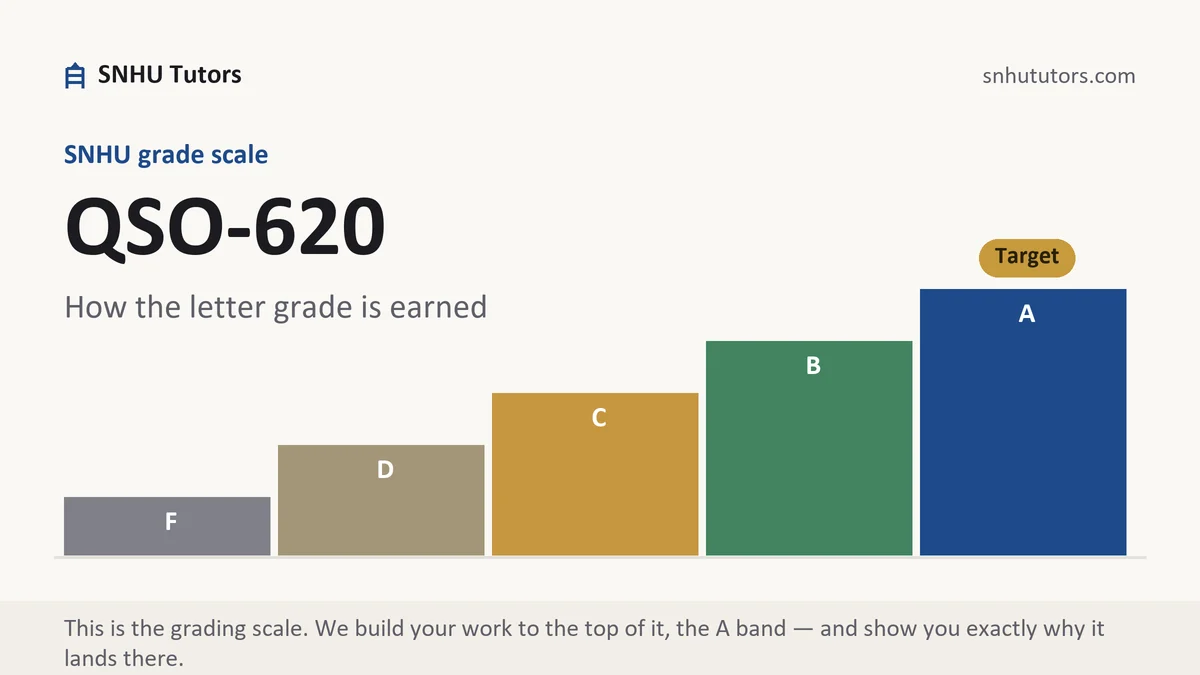
What QSO 620 work must make visible
Open the current syllabus, module directions and Guidelines and Rubric document before building the deliverable. The course title establishes subject territory, but it does not prove whether the current module uses a discussion, paper, case, worksheet, quiz, presentation, code artifact, journal, milestone or final-project component.
Extract the action verbs and give each one a visible destination. Describe requires accurate selection and explanation; analyze requires a relationship, cause, implication or comparison; evaluate requires criteria and judgment; recommend requires an action that follows from evidence. A reader should be able to point to the sentence, table, calculation, slide or artifact that satisfies every row.
For business work, keep the scenario facts, market or organizational data, financial assumptions, stakeholders and decision criteria consistent across the analysis, exhibits and recommendation.
Convert the Guidelines and Rubric document into a map
Create one row per scored criterion with the prompt language, rubric language, planned evidence, destination heading, format requirement and completion test. Keep directions and rubric rows separate until both are accounted for: directions often control audience and format while the rubric controls depth and points.
Use the performance descriptors as revision instructions. If the top band asks for exceptionally clear, nuanced or well-supported work, identify what additional relationship, limitation, counterpoint, calculation or source would make that quality visible. Do not substitute extra length for the missing intellectual move.
Before submission, read only the headings and topic sentences. They should form a compact answer to the assignment. Then read each rubric row and locate its evidence without relying on implication. If a criterion has no obvious destination, revise the structure before polishing prose.
Build the 10-module operating board
Use one row per real Brightspace deliverable: module, item, initial-post deadline, reply deadline, assignment deadline, point value or weight, source needs, milestone dependency, feedback dependency and next action. Do not create 10 assignment rows merely because the term has 10 modules.
Separate discussions, replies and the main assignment. Reserve time for research, analysis, drafting, citation reconciliation, file export and the upload check. For a technical or quantitative artifact, add environment, data, version, calculation and test columns so the finished output can be reproduced.
Protect milestone dependencies early. A decision made in the first stage can determine later data, stakeholders, architecture, scope or recommendations. Record those decisions once and update them deliberately after feedback instead of letting different modules quietly create different versions of the same project.
Handle milestones and the final project as one evidence chain
Not every SNHU course uses milestones, so confirm the current sequence before applying this method. Where it does, treat each milestone as a tested component of the final—not as disposable weekly prose. Preserve corrected analysis, cited sources, calculations, defined terms and scenario facts in a controlled master outline.
When feedback arrives, classify it as missing coverage, weak reasoning, evidence mismatch, calculation error, format problem or unclear communication. Correct the smallest complete unit and trace every dependency. A changed assumption may alter a table, narrative result, risk judgment and recommendation; all four must agree before the revision is done.
Build the final project from the corrected master outline. Reconcile transitions, tense, terminology, headings, figures and references across the whole artifact. Remove milestone-only instructions and repetition. The final should read as one decision made with accumulating evidence, not several old files joined together.
Protect the discussion and reply obligations
Read the current prompt for the required initial-post timing, number of replies, source expectations and response depth. Draft the initial post around one clear claim, a specific application and appropriate support. A general summary may be accurate while still missing the analytical or experiential connection the rubric scores.
Replies need new value. Extend a peer's point with a source, compare another interpretation, test an assumption, ask a focused question and explain why it matters, or connect the idea to the course framework. Agreement plus praise rarely demonstrates the engagement criterion by itself.
Keep discussion facts and professional context truthful and de-identified. Never invent workplace, patient, client or organizational experience to make a post sound specific. Use a clearly labeled hypothetical only when the prompt permits it.
Build evidence that fits the claim
Use authoritative primary material for law, regulation, standards, official statistics and organizational policy; peer-reviewed research for effects and mechanisms; and the assigned scenario or dataset for local analysis. Record author or issuer, date, population, jurisdiction, limitation and destination as each source enters the draft.
Match the strength of the claim to the source. Descriptive data can establish context but not causation. A professional standard can support what should happen but not prove that a local organization already does it. When evidence is indirect, mixed or old, disclose that limitation and narrow the conclusion.
Reconcile every citation and number mechanically. Each in-text citation needs a reference, each reference needs a use, every figure needs a label and source, every percentage needs a base and period, and every table must agree with the prose. Correct-looking outputs still fail when their inputs cannot be traced.
Turn grader feedback into the next module's control
Store the exact feedback, the rubric row, its category, the corrected pattern and one prevention rule. A comment about support may mean the source is missing, weak, too old, aimed at another population or disconnected from the claim. Diagnose the failure before adding citations.
Carry the method forward, not old sentences. The next module should inherit better criterion mapping, earlier research, clearer calculations, more visible comparison or a stronger file check. Reusing prose from a different prompt can preserve the very assumption the grader rejected.
Update the grade forecast only from current points and weights. Keep missing, excused and ungraded items distinct. The target is a durable A-range process with margin, but the registered syllabus—not a generic percentage assumption—controls the actual letter-grade calculation.
Where QSO 620 sits in the program network
Open the exact program page to see why SNHU publicly names this class. A course can serve multiple degrees or concentrations, and its role can differ across them. The student's current academic evaluation remains authoritative after transfer and elective choices.
The work that remains the student's
The student owns the real research choices, calculations, scenario decisions, discussion participation, authenticated work and final submission.
Tutoring can explain concepts, map a rubric, review a de-identified draft, check calculations or code, rehearse a presentation and help the student respond to feedback. It cannot enter Brightspace, post as the student, take an exam, invent experience, perform a clinical or workplace activity, log hours or submit coursework.
The modules, one by one
No public module manual is claimed for QSO 620 yet. The official program source verifies the class identity, while the current Brightspace shell controls Module 1 through Module 10. A manual will be added only from a verified real deliverable—not from the term calendar.
Run the final submission check
First run a content pass: every rubric row answered, reasoning explicit, evidence fitted to the claim, calculations reproducible, limitations visible and professional boundaries intact. Then run a delivery pass: template, filename, file type, length, speaker notes, accessibility, references, links and required attachments.
Open the exported file and inspect it. Confirm that no text is clipped, no tracked change or comment remains, no private data appears, and the correct file opens after upload. Record the receipt or timestamp, then return to the module board when feedback posts.
Keep the working draft, exported submission and upload receipt as three distinct records. If Brightspace converts or previews the file, compare that rendered copy with the source. Tables, formulas, slide notes, alt text, page breaks and embedded media can change during export even when the editable file looked correct.
After submission, freeze that version until feedback arrives. Record any later correction as a new version with the reason for change, then trace it through every dependent claim, calculation, visual and reference. That small discipline prevents a revised exhibit from disagreeing with an older narrative paragraph.
Questions about QSO 620
What is QSO 620 at SNHU?
Where are the module assignments?
How should an SNHU milestone be drafted?
Can tutoring submit or perform experiential work?
Working on QSO 620 now?
Send the current module directions and Guidelines and Rubric document. Support begins from the real instrument and keeps the final decisions with the student.