This page is ENG 122’s help desk: the honest read on what the course grades and the exact support behind it. The course: English Composition I, on the Gen-ed core path at SNHU.
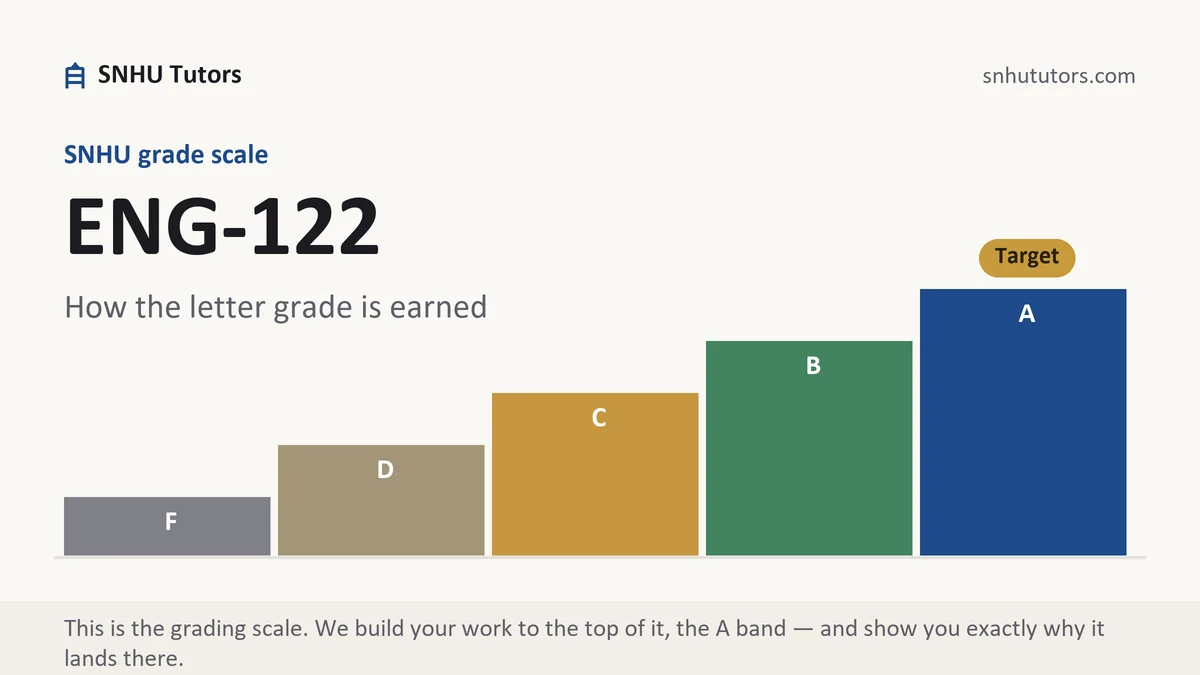
What ENG 122 actually grades
SNHU's front-door writing course, and a process-graded one: outlines, drafts, peer review, and revisions all carry rubric points on the way to the finished essays. It quietly teaches the criterion-mapped writing style every later course assumes, which is why struggling here taxes the whole degree.
How we help in this course
We support the arc, not just the artifact: each process piece drafted to its criteria, the final essays built from them, and walkthroughs that make the method portable. Students who start supported in ENG 122 tend to need less help everywhere afterward, which is the correct direction for tutoring to point.
Service terms are the site standard: deliverables drafted to the course's Guidelines and Rubric documents in 24 to 48 hours, discussions same-day when needed, criterion map and walkthrough included, projected grade stated, and free revision until the target letter grade posts.
Module manuals for this course
Module-level manuals for ENG 122, its discussions, milestones, and final, publish as each identity verifies against the current course build; chat knows live coverage same-day, and the service never waits on a manual.
In ENG 122 right now?
Send the module and the Guidelines and Rubric document from Brightspace. First premium sample free, back in 24 to 48 hours.
Grading the journey: how process pieces score
ENG 122 is unusual among first courses in that the scaffolding itself is graded. Outlines, working drafts, peer-review contributions, and revisions each carry rubric points on the way to the finished essays, all scored against their own Guidelines and Rubric documents with the criteria weighed independently. Because criteria cannot subsidize one another, a beautiful final essay sitting on skipped process checkpoints still bleeds points, and the reverse is also true: dutiful process work around a mediocre essay holds a grade together surprisingly well. The course is teaching SNHU's rubric culture by making you live inside it.
Support here follows the arc rather than the artifact. Each process piece is drafted to its own criteria, the essay grows out of the same skeleton so the trail reads coherent in Brightspace, and the walkthroughs narrate the method so it becomes portable to every writing-bearing course after this one.
Opening the relationship on the writing course
A composition course is the cheapest possible audition for a writing service, and the first sample is free. Send the current module's prompt with its rubric document, and the draft returns inside 24 to 48 hours with a criterion map pairing every rubric row to the passage that answers it. Discussions, where the module includes them, go same-day when the clock demands it.
The rest is the site standard: a flat quote in minutes, two independent QA passes before delivery, free revision until the A-range grade posts, and submission always done by you through your own Brightspace. Students who start supported in the first writing course typically need less help later, which is the direction tutoring should point.